

Why Founders Become Bottlenecks as Their Company Grows
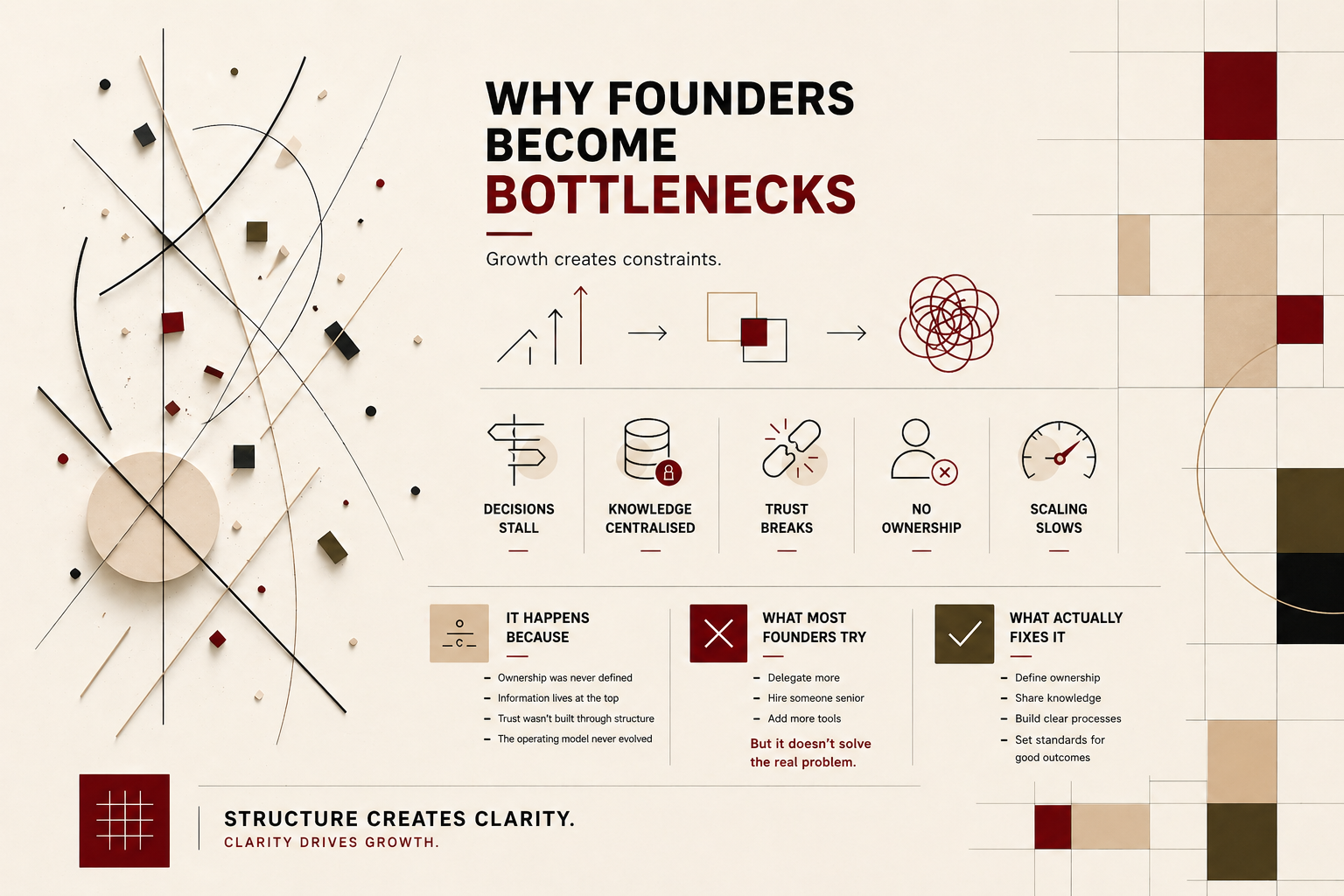
Most founders don't see it happening.
One day you're the person holding everything together — making fast decisions, knowing every detail, keeping the team moving. That's exactly what the early stage requires. And it works.
Then the company grows. The team gets bigger. More is happening. And somehow, instead of things getting easier, they get slower. Decisions stall. People are waiting on you. Execution lags. You're busier than ever, but the company isn't moving as fast as it should.
At some point, someone says it — or you feel it yourself: you've become the bottleneck.
It's one of the most common challenges in growing companies, and one of the most misunderstood. Here's why it actually happens — and what it takes to fix it.
It Starts as a Strength
The qualities that make founders effective in the early stages are the same ones that create bottlenecks later.
Speed. Decisiveness. Deep context. The ability to move fast because you know everything and trust yourself to get it right.
In a five-person company, that's not a problem — it's an advantage. You can hold the full picture in your head. You're close enough to everything that your involvement makes things faster, not slower.
But as the company scales, those same qualities stop being assets. The team grows. Decisions multiply. Complexity increases. And the founder who was the engine of speed becomes the constraint on it.
This transition catches most founders off guard — because nothing changed in how they operate. What changed is the size and complexity of what's around them.
Why It Keeps Happening
There are a few structural reasons founders become bottlenecks. Understanding them is the first step to addressing them.
1. Ownership was never defined
In the early days, everyone does everything. Roles are fluid by necessity. The founder makes the calls because there's no structure that says otherwise.
As the team grows, that informality doesn't automatically resolve itself. If it was never explicitly decided who owns what — who has the authority to make which decisions — everything defaults back to the founder. Not because the team can't decide, but because the structure doesn't give them permission to.
The result: questions that should have a clear answer keep escalating. Not because your team is incapable, but because the ownership was never established.
Unclear ownership is also one of the main reasons teams appear to underperform when the real problem is the system around them.
2. Information lives at the top
Founders accumulate context over years. You know the history of every decision, the reasoning behind every process, the nuance behind every client relationship. That knowledge lives in your head — and when it's not documented or shared, it creates dependency.
Team members need to come to you, not because they can't think for themselves, but because you hold the information they need to think with. Every question that reaches you is a symptom of a knowledge gap somewhere in the organization.
3. Trust wasn't built through structure
Many founders struggle to delegate because they've been burned before. Someone dropped the ball. A decision was made they disagreed with. A project went sideways.
The instinct is to hold on tighter. But the problem usually isn't the person — it's that the structure wasn't there to support them. No clear process. No defined scope. No way to know what "good" looks like. When people don't have those things, failure rates go up — and the founder pulls back in.
It becomes a cycle: poor structure leads to poor outcomes, which leads to less delegation, which leads to more bottlenecks.
4. The company scaled, but the operating model didn't
This is the most common root cause. The team doubled. Revenue grew. Complexity increased. But the way the company actually operates — how decisions get made, how information flows, how ownership is structured — never evolved.
You're running a 40-person company with the informal systems that worked when there were eight of you. Of course it's breaking down.
This is often the stage where the signs your startup has outgrown its processes start showing up all at once.
What Most Founders Try First (And Why It Doesn't Work)
The first instinct is usually to delegate more. Just hand things off. Trust the team.
But delegation without structure doesn't work. If the underlying system hasn't changed — if ownership is still unclear, if information is still siloed, if there's no defined process for how decisions get made — the same problems come back. The founder steps back, something falls through, they step back in.
The second instinct is to hire. Bring in a senior person. Make them responsible.
Hiring helps, but it doesn't solve the structural problem. A new VP or Head of Operations will run into the same walls if the foundation isn't in place. You're adding a person into a broken system.
The fix isn't more delegation or more headcount. It's building the structure that makes delegation possible.
What Actually Fixes It
Getting yourself out of the bottleneck position is a structural problem that requires a structural solution.
That means being honest about a few things:
Where are decisions actually getting stuck? Not the occasional exception — the recurring pattern. What types of decisions keep coming back to you? That's where ownership needs to be defined.
What information only lives in your head? What does your team not know, not have access to, or not understand — that's forcing them to rely on you? That's where documentation and knowledge transfer need to happen.
What does "good" look like for the things you're trying to hand off? If you can't clearly articulate what a good outcome looks like, your team can't either. Defining standards and expectations is what makes delegation stick.
What are the decisions only you should be making? Being a bottleneck doesn't mean stepping back from everything. It means getting clear on what genuinely requires you — and systematically removing yourself from everything that doesn't.
The structural shift this requires is what I cover in why your startup feels chaotic — and how to fix it with better operations.
The Goal Isn't to Step Away — It's to Work at the Right Level
Removing yourself from the bottleneck position isn't about becoming less involved. It's about shifting where your involvement happens.
Founders should be setting direction, making high-stakes decisions, and building relationships. Not approving expense reports, answering questions that should have a documented answer, or being the only person who knows how something works.
When the structure is right, your team moves faster without you — and you can focus on the things only you can do.
That's what operational clarity makes possible.
Where to Start
If you're reading this and recognizing your own situation, the first step is understanding exactly where the bottlenecks are — and why they exist.
I've put together a free operations playbook that walks through the most common operational issues in growing tech companies, including the structural patterns that create founder bottlenecks and how to start untangling them.
Download the Operations Playbook →
It's a practical starting point — and a good way to get clarity on what needs to change.