

Signs Your Startup Has Outgrown Its Processes (And What to Do About It)
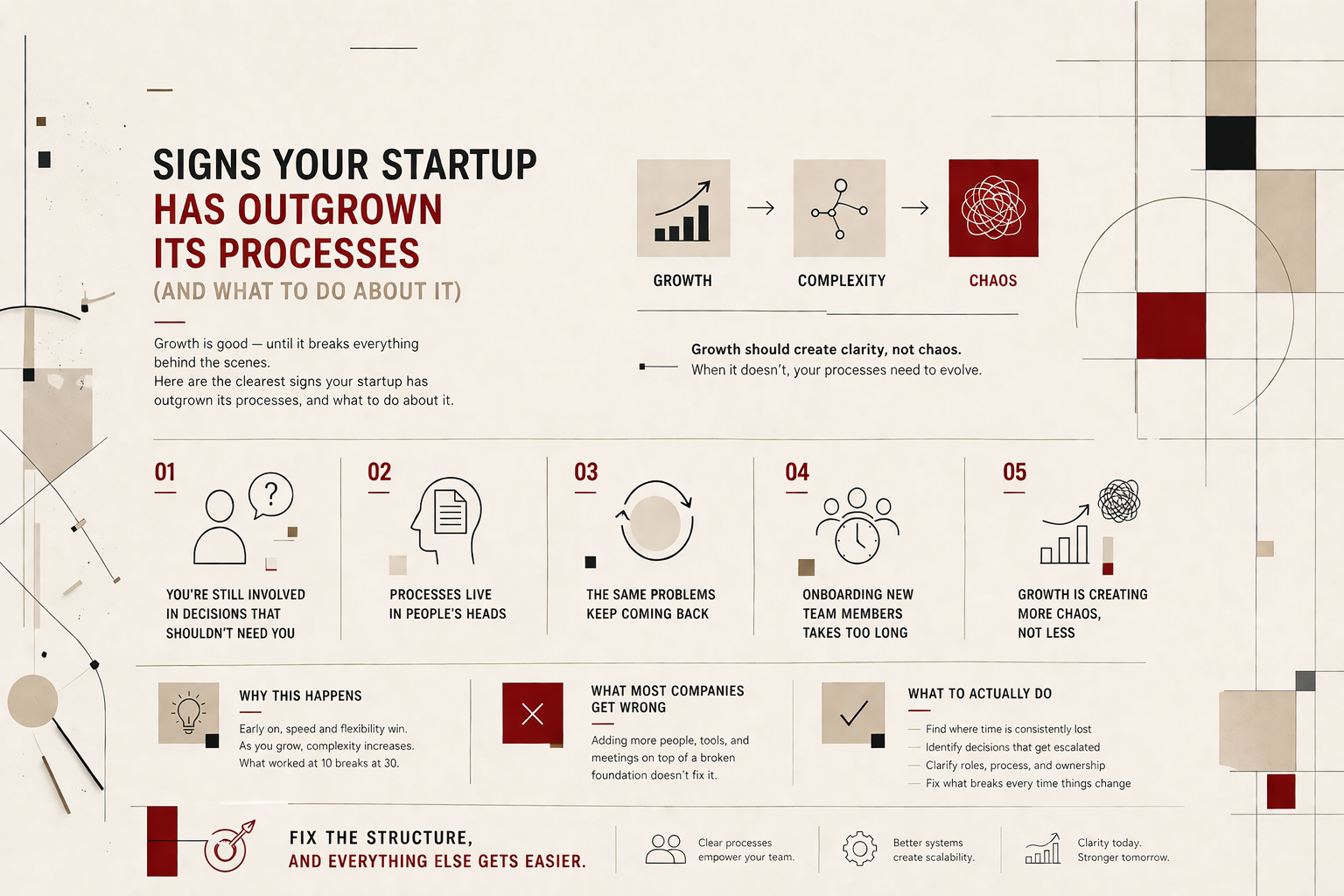
There's a specific moment most founders recognize in hindsight.
The company is growing. Revenue is up. The team is bigger. From the outside, things look good. But inside — something feels off. Decisions are slower. Things fall through the cracks. You're in more meetings, not fewer. Everyone's busy, but execution feels harder than it used to.
That's not a people problem. That's a processes problem.
And it's one of the most predictable challenges in business: your operations haven't kept up with your growth.
Here's how to know if that's where you are — and what to do about it.
The Signs Your Startup Has Outgrown Its Processes
1. You're still involved in decisions that shouldn't need you
This is usually the first thing founders notice. Questions that should have a clear answer — that should be handled by someone on the team — keep landing back on your desk.
It's not that your team is incapable. It's that the structure doesn't exist to let them decide without you. No clear ownership, no documented criteria, no defined process. So everything escalates.
If you're the answer to too many questions, that's a structural problem — not a delegation problem.
Does this resonate with you?, this post goes deeper into why founders become bottlenecks — and the structural reason it keeps happening.
2. Processes live in people's heads
When the team was small, this worked fine. Everyone knew what to do because they'd figured it out together. Knowledge was shared informally, and things got done.
As the team grows, that stops working. New people join and take months to get up to speed — not because they're slow, but because there's nothing written down. Experienced team members become bottlenecks because they hold all the context. And when someone leaves, they take critical knowledge with them.
If your processes exist primarily in people's heads, you don't have processes — you have habits. That's a fragile foundation to scale on.
3. The same problems keep coming back
You solve something, and a few weeks later it surfaces again. A different context, a different team member — but the same root issue.
This usually happens because fixes are being applied at the symptom level, not the structural level. The process that allowed the problem to happen in the first place hasn't changed. So the problem returns.
Recurring issues are one of the clearest signals that your operations need structural attention, not just repeated firefighting.
4. Onboarding new team members takes too long
Hiring solves capacity problems — but only if new people can get up to speed quickly. When they can't, growth creates drag instead of momentum.
Long onboarding times are almost always a documentation and structure problem. If there's no clear process for how things work, every new hire has to figure it out from scratch. That slows them down, and it takes time away from the people training them.
If adding people feels harder than it should, your processes aren't ready to scale.
When these two show up together, it's almost always a system problem, not a people problem. Here's how to tell the difference.
5. Growth is creating more chaos, not less
There's an assumption that things will get easier as the business grows — more resources, more people, more capacity. But for many companies, the opposite happens. Growth creates more coordination problems, more communication gaps, more things to manage.
That's the signal. Growth should enable execution, not complicate it. If scaling is making things harder to run, the operational foundation isn't keeping up.
Why This Happens
None of this is a failure. It's actually a predictable stage of company growth.
In the early days, moving fast and staying flexible is the right strategy. You don't need documented processes when there are four people and you're still figuring out the product. Informal coordination works when everyone is in the same room — or the same Slack channel.
But as the company grows, complexity increases. More people, more decisions, more interdependencies. What worked at ten people breaks at thirty. What worked at thirty breaks at a hundred.
The problem isn't that your team built the wrong habits early on. The problem is that the structure hasn't evolved to match where the business actually is now.
This is the broader pattern behind what I call startup chaos — and why better operations are the fix, not just more hustle.
What Most Companies Get Wrong
The instinct when things feel chaotic is to add more — more people, more tools, more meetings, more process documentation.
But adding more on top of a broken foundation doesn't fix the foundation. It makes it harder to see the real problem.
More headcount doesn't fix unclear ownership. More project management tools don't fix the absence of actual processes. More check-in meetings don't fix the lack of clarity that's causing misalignment in the first place.
The fix isn't addition. It's structural clarity.
What to Actually Do
If you recognize your company in the signs above, the first step isn't to redesign everything at once. It's to understand what's actually breaking — and why.
That means stepping back from the symptoms (the chaos, the slow decisions, the recurring issues) and looking at the root causes underneath them.
A few questions worth asking:
Where is time consistently being lost? Not one-off situations — the recurring patterns.
What decisions get escalated that shouldn't? What would need to be true for those to be handled without you?
Where does the team lack clarity? About roles, about process, about who owns what?
What breaks every time something changes — a new hire, a new client, a new product phase?
The answers tell you where the structural gaps are. That's where the work starts.
Where to Start
If you're seeing several of these signs in your company, that's a clear signal that your operations need attention before you scale further.
The good news: these are fixable problems. With the right structure, decisions get clearer, execution gets faster, and the founder stops being the answer to everything.
I've put together a practical starting point — an operations playbook covering the most common operational challenges in growing tech companies and how to approach them.
Download the Operations Playbook →
It's free, and it's a good first step if you want to understand where your operations stand.